


🚀
GUIDE GRATUIT
RFP Chatbot : Ne partez pas d'une page blanche
Un mode d'emploi pensé pour les métiers avec un guide pas à pas pour rédiger chaque section de votre appel d'offres.
Méthodologie guidée : Quoi écrire dans chaque chapitre (Contexte, Fonctionnel, Tech)
Concepts clés décryptés : RAG, LLM, Base de connaissance
Modèles inclus : Structures prêtes à l'emploi pour vos cas d'usage
👉 Télécharger le guide
Knowledge gaps, the questions your AI chatbot cannot answer because the information is missing from its knowledge base, are its biggest source of improvement. Of all the signals you can draw from a conversation, this is the one that turns most directly into concrete work: writing or correcting content. Here is how to detect them across 100% of conversations, read the figure and fix them in an hour.
These failed conversations leave no trace. The customer asks a question, the bot replies “I don’t have that information”, and the customer leaves, with no ticket, no vote and no handover.
Definition. A knowledge gap is a conversation in which the bot did not have the general information needed to answer the user’s request. A topic’s knowledge gap rate is the share of its conversations where this happened.
Key takeaways
A knowledge gap tells you why a conversation failed: the information was missing. The problem has a clear owner and a direct fix.
A correct redirection is not a knowledge gap: the metric measures missing knowledge, not access to personal data.
Below 15% per topic, the rate is healthy. From 15 to 30%, it needs watching; from 30%, it signals a content emergency.
Prioritise topics by the number of conversations affected, not by percentage.
The fix takes an hour: find the topic, read its conversations for fifteen minutes, write the content, then measure again three weeks later.
A knowledge gap tells you why a conversation failed
The resolution rate tells you that a conversation failed; a knowledge gap tells you why: the information was missing. It is a precise problem, with an obvious owner, the team that writes the knowledge base, and an almost identical fix every time: write or correct the content.
An AI agent answers from what it finds in its knowledge base: if the information is not there, it cannot give it. A topic that combines low resolution with a high knowledge gap is therefore the cheapest point to fix. Start there, before reworking the flows.
How do you detect knowledge gaps across 100% of conversations?
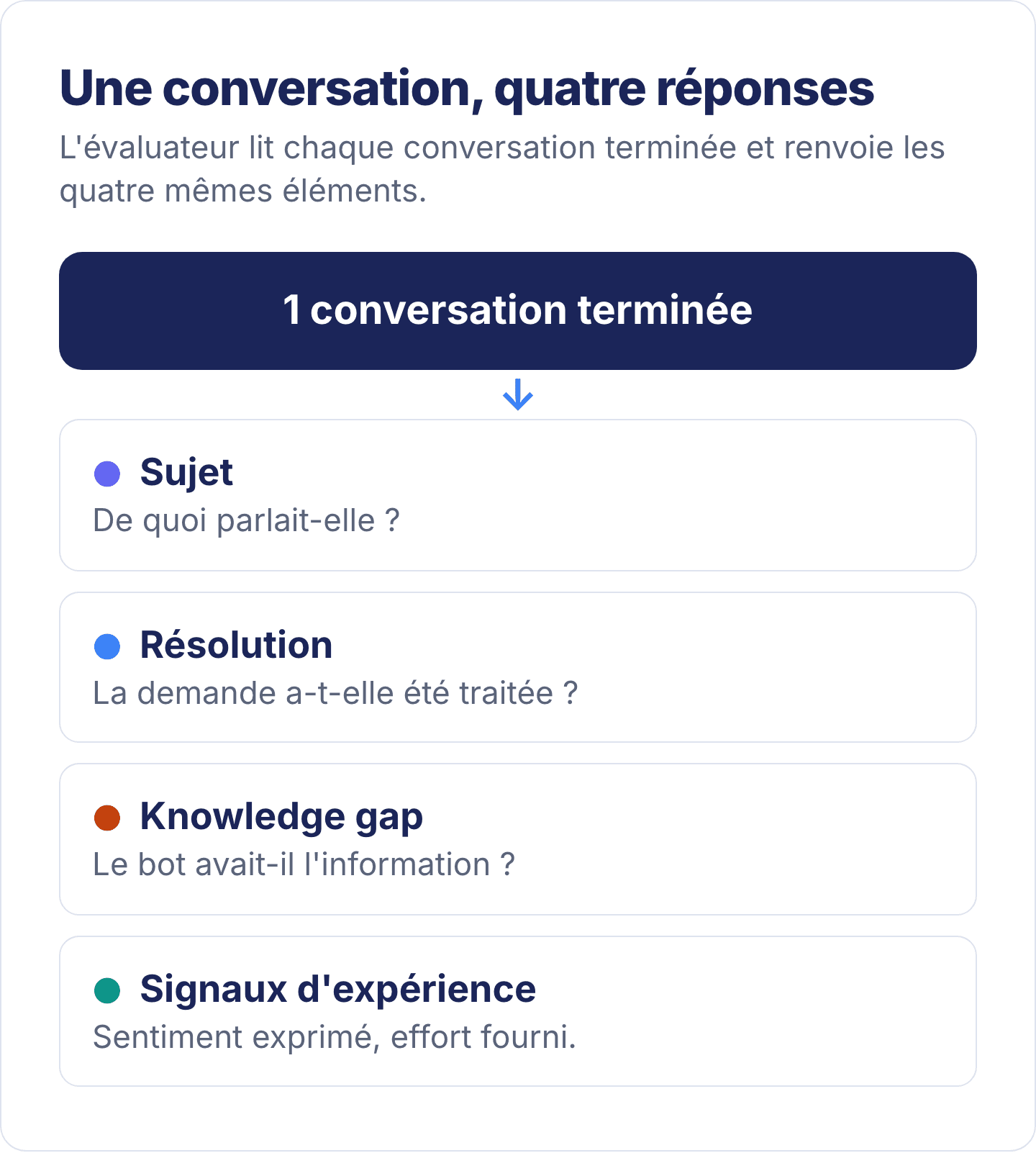
Nobody reads 50,000 conversations a year. At ViaSay, a French provider of conversational assistants, an AI evaluator separate from the bot reviews every completed conversation and checks, among other things, whether the bot had the information requested. The verdict is recorded for each conversation, with its reasoning, then aggregated by topic.
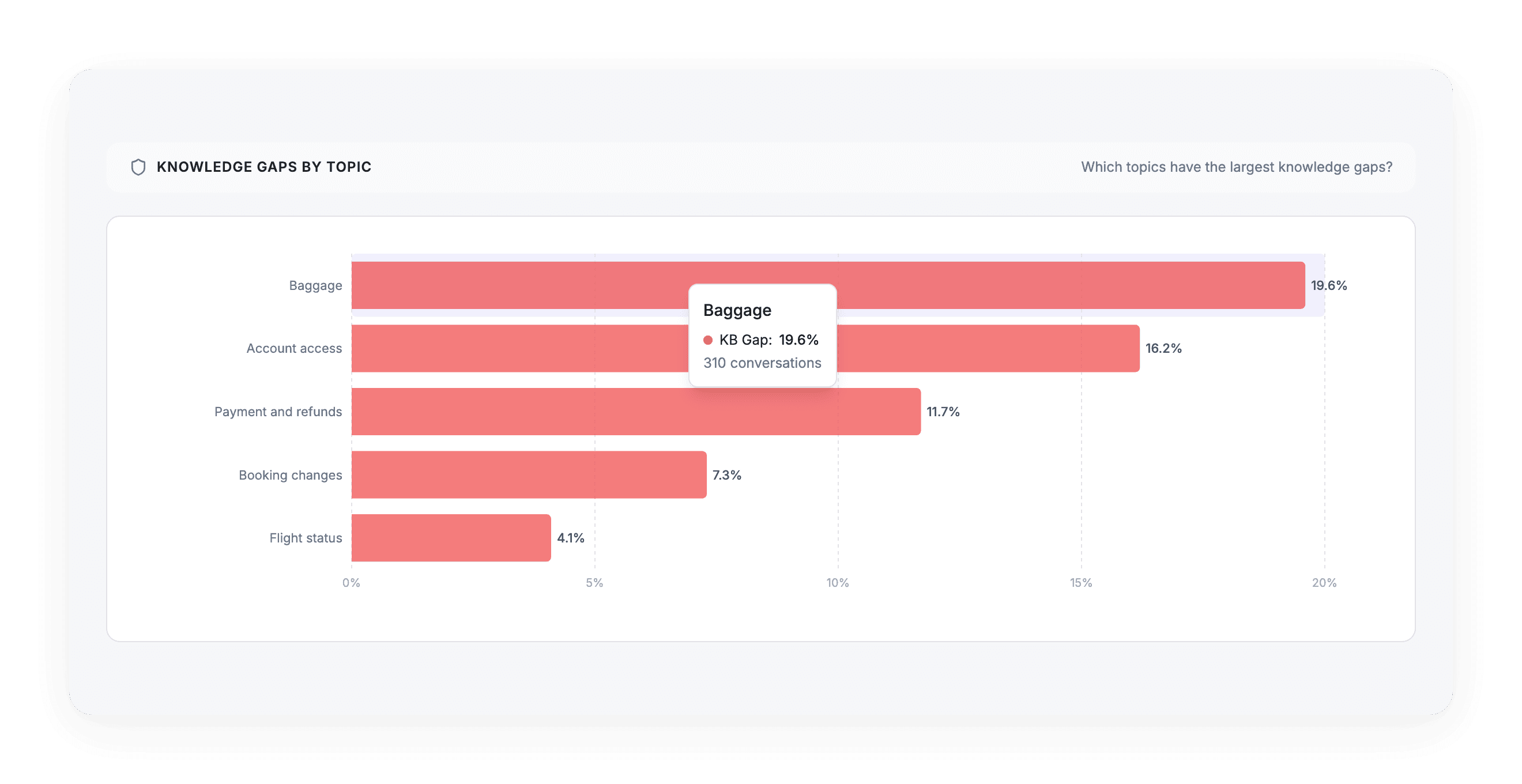
In the Performance tab, the result takes the form of a table of knowledge gaps by topic.
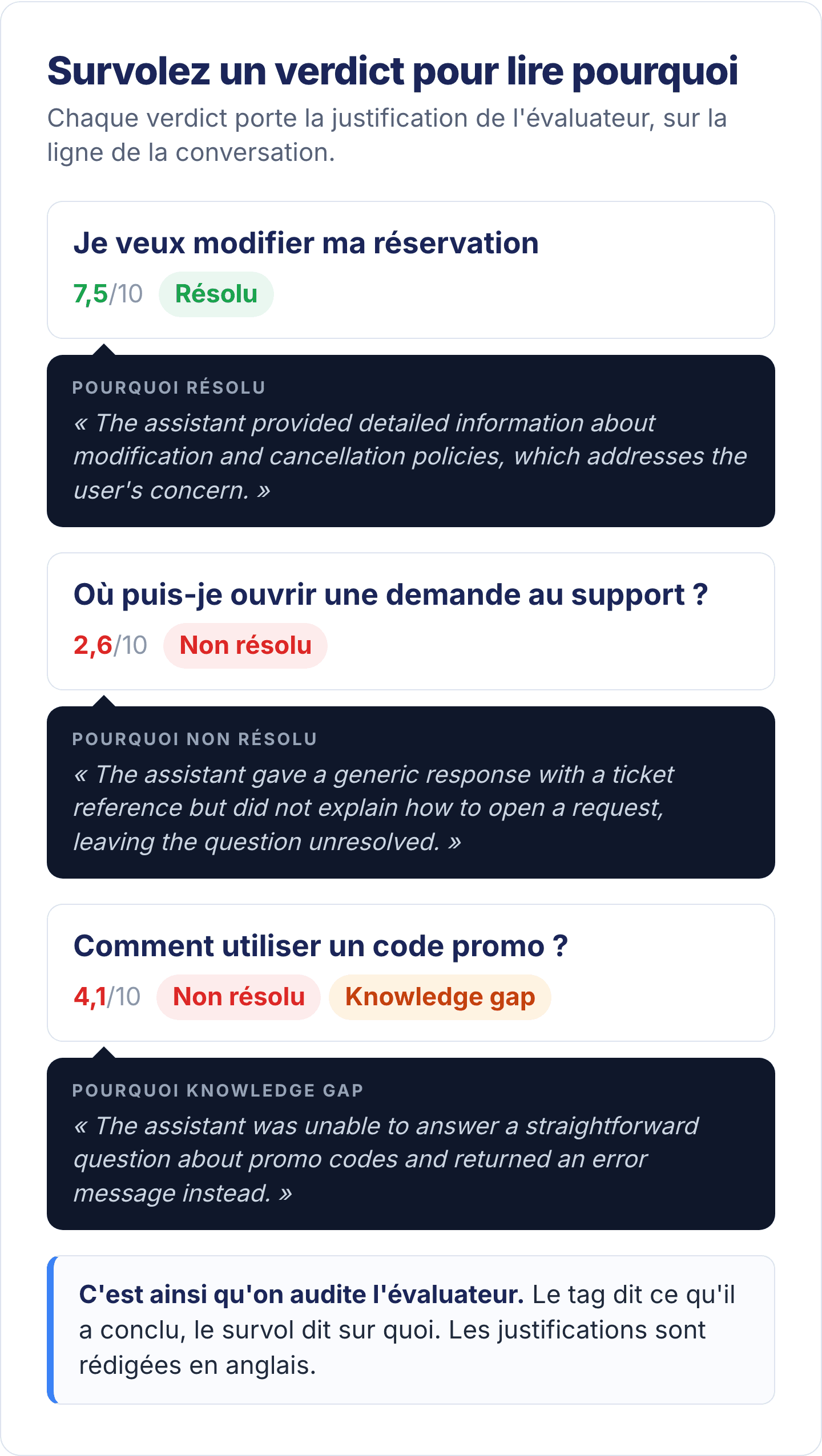
On each flagged conversation, hovering over the tag explains what was missing.
What counts as a knowledge gap?
A knowledge gap is counted when the bot clearly does not have the general information requested and replies “I don’t know”, or refuses without any useful guidance. A correct redirection to personal data is not one: without this distinction, false positives would fill the metric and nobody would look at it any more.
This is a knowledge gap. “What is your refund policy?” → “I don’t have that information.”
This is not a knowledge gap when the bot provides the information. Nor is it one when the bot has no access to personal or real-time data, but redirects the user to the valid place where it can be found. “Am I entitled to a refund on my booking?” → “Here is your customer account, under My bookings.”
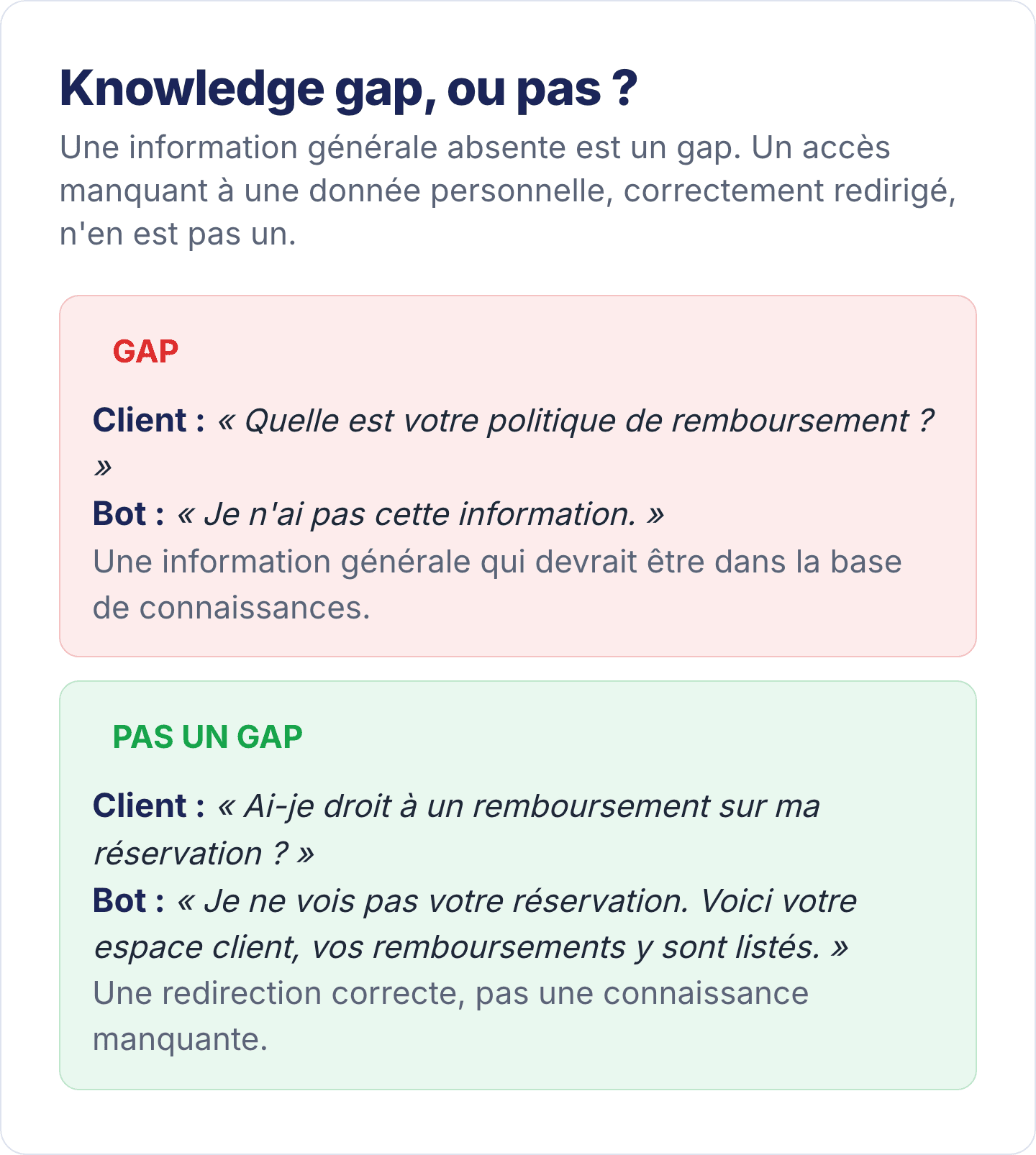
The bot does not need to know a customer’s balance, but it does need to know where the customer can check it. The metric measures missing knowledge, not access to databases.
From a 30% knowledge gap, a topic needs content urgently
A knowledge gap rate below 15% is healthy and a rate of 15 to 30% needs watching. From 30%, nearly one conversation in three runs into missing information: the content for that topic becomes an emergency.
Knowledge gap rate | What it means |
|---|---|
Below 15% | Healthy |
15 to 30% | Needs watching |
30% and above | Content emergency on this topic |
To prioritise, do not rank topics by percentage. A topic with a 40% gap over 30 conversations represents 12 unanswered questions; a topic at 18% over 2,000 represents 360. The ViaSay table already sorts by the number of conversations affected.
How do you fix a knowledge gap in an hour?
The method comes down to four steps and an hour of work. Find the topic where knowledge gaps are concentrated, read the conversations that explain them, write or correct the content, then measure the same topic again three weeks later. That last measurement shows the effect of the fix.
1. Find the topic where knowledge gaps are concentrated
In the Performance tab, open the Knowledge Gaps by Topic table. Choose the topic with the most conversations in gap, not the one showing the most worrying percentage.
2. Read the conversations behind it
Click on the topic: this is the step that produces your to-do list. A knowledge gap points to the topic, not the missing article, because the system cannot write your content for you.
Fifteen minutes of reading gives you a very precise list. For example: “seven people asked about baggage rules on a connecting flight, and we have nothing on this”.
As you read, separate general information that is genuinely missing, which needs writing, from personal data that was correctly redirected, which no content will fix.
3. Write or correct the content
Add the missing articles, or rewrite those that existed but were not being used. The Article Performance table, in the same tab, shows how your existing articles are performing.
If an article performs poorly on a topic with a high gap, the content usually exists. It is then badly titled, buried, or written for a different question from the one people ask.
Tackle one topic at a time: if you rewrite ten articles across five topics and the rate moves, you will not know which change moved it.
4. Measure the same topic again three weeks later
A falling gap rate shows you are heading in the right direction. If the topic’s resolution rate has risen at the same time, the content was the bottleneck, and you have just removed it.
Two situations show the problem is not missing content
A knowledge gap does not always point to an article to write. If the bot does not use information that is in the knowledge base, it is the writing that needs fixing. If it has the information and conversations still fail, the cause lies somewhere other than the content.
First case: a high gap, even though the answers exist in the knowledge base. The problem is not content coverage, but content quality: an article that is badly titled, buried, or written for a different wording. The existing writing needs correcting.
Second case: a low gap and low resolution. The cause lies in the flow, or in the service behind the answer. In that case, turn to the method for improving the resolution rate, and read the conversations looking for a flow problem.
In a scripted flow, a knowledge gap signals the need for a generative AI step
A knowledge gap in a scripted flow, meaning a decision tree without generative AI, is a particular signal. The user asked a question the tree did not anticipate, and nothing could go and look for the answer. No content will fix this as long as the flow remains scripted.
That topic is usually the best candidate for a generative AI step: the information exists or can be written, and all that is missing is something to look for it.
The AI Impact section of the Overview tab compares the knowledge gap rate of conversations handled by AI with that of scripted flows. On the instances we monitor, the gap is generally clear in favour of AI.
See your knowledge gaps, topic by topic
A 30-minute demo on your conversations, with the gaps table and the reasoning behind each verdict.
Frequently asked questions
What is a knowledge gap in a chatbot? It is a conversation in which the bot did not have the general information requested (a policy, a price, a procedure) and could not answer. A correct redirection to personal or real-time data, such as a customer account area, is not a knowledge gap.
How can I detect the questions my chatbot cannot answer? Have every completed conversation reviewed by an AI evaluator that judges whether the bot had the information, then aggregate the results by topic. Search logs and customer votes only cover a fraction of cases; AI review covers 100% of conversations.
What knowledge gap rate is acceptable? Below 15% per topic, the situation is healthy. Between 15 and 30%, the topic deserves a content review. Above 30%, nearly one conversation in three fails for lack of information: it is a priority.
How do you fix a knowledge gap? Read the topic’s conversations to identify exactly what is missing. Then write or correct the content, one topic at a time, and measure the same topic again three weeks later.
Can a scripted chatbot have knowledge gaps? Yes, when the user asks a question the decision tree did not anticipate. No content will fix it as long as the flow remains scripted; it is usually the first topic where you should add a generative AI step.
