


🚀
GUIDE GRATUIT
RFP Chatbot : Ne partez pas d'une page blanche
Un mode d'emploi pensé pour les métiers avec un guide pas à pas pour rédiger chaque section de votre appel d'offres.
Méthodologie guidée : Quoi écrire dans chaque chapitre (Contexte, Fonctionnel, Tech)
Concepts clés décryptés : RAG, LLM, Base de connaissance
Modèles inclus : Structures prêtes à l'emploi pour vos cas d'usage
👉 Télécharger le guide
A chatbot’s CSAT only reflects the views of customers who vote, and more than nine in ten never do. That does not make it a bad metric: it is a survey, with low participation and unrepresentative participants. Here is what a chatbot’s CSAT really measures, how to measure the experience across every conversation with a CX Score, and what to do when the two disagree.
Take a CSAT of 82%: that is a good figure. Yet it rests on a few hundred thumbs up, among the tens of thousands of customers who talked to the bot this month. The customer who got a perfect answer and the one who gave up in anger leave the same trace in your data: a conversation, with no vote.
Key takeaways
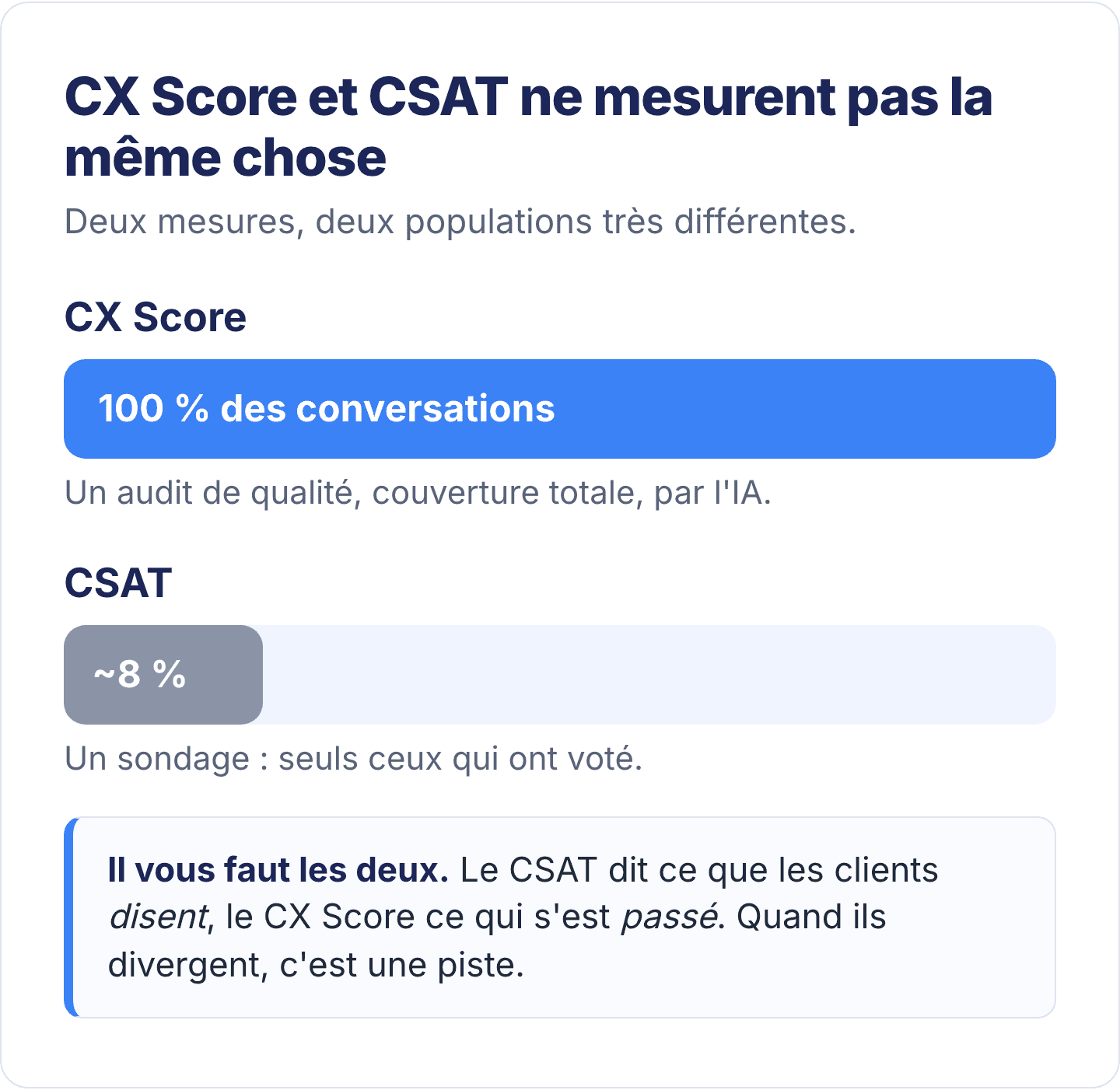
A chatbot’s CSAT is a survey. The median response rate for satisfaction surveys is around 10%, and voters are mostly the very happy and the very unhappy.
The CX Score is an audit. An AI evaluator scores every completed conversation out of 10: 40% for resolution, 30% for sentiment, 30% for effort.
Keep both. CSAT tells you what customers say; the CX Score tells you what happened.
When they disagree, that is a lead. A high CSAT with a low CX Score points to a poorly served silent majority; a low CSAT with a reasonable CX Score, to a problem outside the bot.
To act, rank your topics by Volume × (10 − CX Score), then fix the component that is dropping, starting with resolution.
A chatbot’s CSAT only measures the views of those who vote
A chatbot’s CSAT is the share of positive votes among customers who answered the satisfaction question at the end of the conversation. A positive vote is a thumbs up, or 4 and 5 on a 5-point scale. Everything hinges on “who answered”: most customers do not vote.
The median response rate for CSAT surveys is around 10%, according to the 2026 overview published by TruRating. It falls to 7.6% for a survey shown in a window embedded in a website, with wide variations depending on channel and timing.
On a chatbot, the question comes after the customer has got what they wanted, or not. Participation there is often even lower: in practice, more than nine customers in ten never vote.
Those who do vote are mostly the very happy and the very unhappy. The average customer, who got a correct answer in two messages, closes the window without voting.
So CSAT measures the stated opinion of a polarised minority. That is real, even valuable, information, but it is not “your customers’ satisfaction”.
The CX Score evaluates every completed conversation, without waiting for a vote
To understand the experience of customers who do not vote, you have to read their conversations. At ViaSay, an AI evaluator, separate from the bot, reviews every completed conversation and derives, among other things, a CX Score. This score from 0 to 10 combines the resolution of the request (40%), the sentiment expressed by the user (30%) and the effort they had to make (30%).
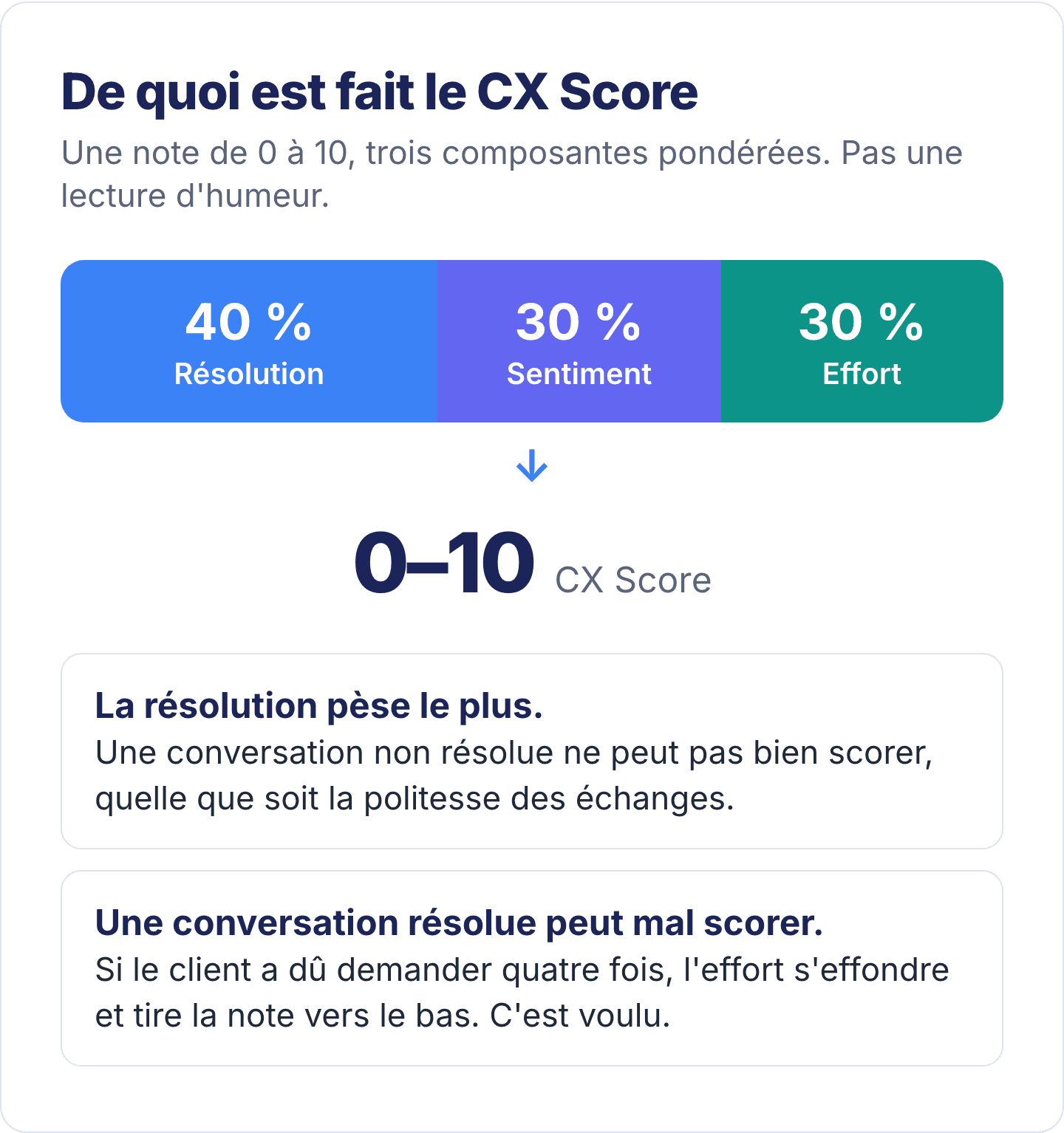
The CX Score is not a guessed mood. Three points matter:
Resolution carries the most weight. An unresolved conversation cannot get a good score, however polite the exchange. This is intentional: the resolution rate is what you should fix first.
A resolved conversation can get a poor score. If the user had to rephrase four times before being understood, effort collapses and pulls the score down. A request settled at the cost of an exhausted customer is not a good experience, and the score says so.
Sentiment only takes into account what the user wrote: thanks, irritation, an explicit complaint. The evaluator is not allowed to guess an emotion that was not expressed.
To read the CX Score, remember three thresholds:
7 and above: the experience is healthy;
from 5 to 7: it is mixed and worth investigating;
below 5: something is wrong on this segment.
Its real value is comparative. Rank your topics by CX Score: the bottom of the list shows you where your customers have the worst time.
What is the difference between CSAT and the CX Score?
The CX Score is not “an AI-generated CSAT”: CSAT is an opinion survey with low participation, which tells you what customers say. The CX Score is a quality audit that covers every conversation: it tells you what happened. So you need both.
Who produces it. CSAT comes from your customers, who click; the CX Score from an AI evaluator, which reads the conversation.
Method. CSAT is an actual vote, thumbs up or down; the CX Score is a composite score of resolution, sentiment and effort.
Coverage. CSAT covers conversations where someone voted, a small minority; the CX Score covers every completed conversation.
What it captures. CSAT captures stated opinion; the CX Score, the quality of the interaction as it actually unfolded.
Bias. CSAT depends on who bothers to vote: the very happy and the very angry. The CX Score depends on the evaluator’s judgement, which is imperfect but applied identically everywhere.
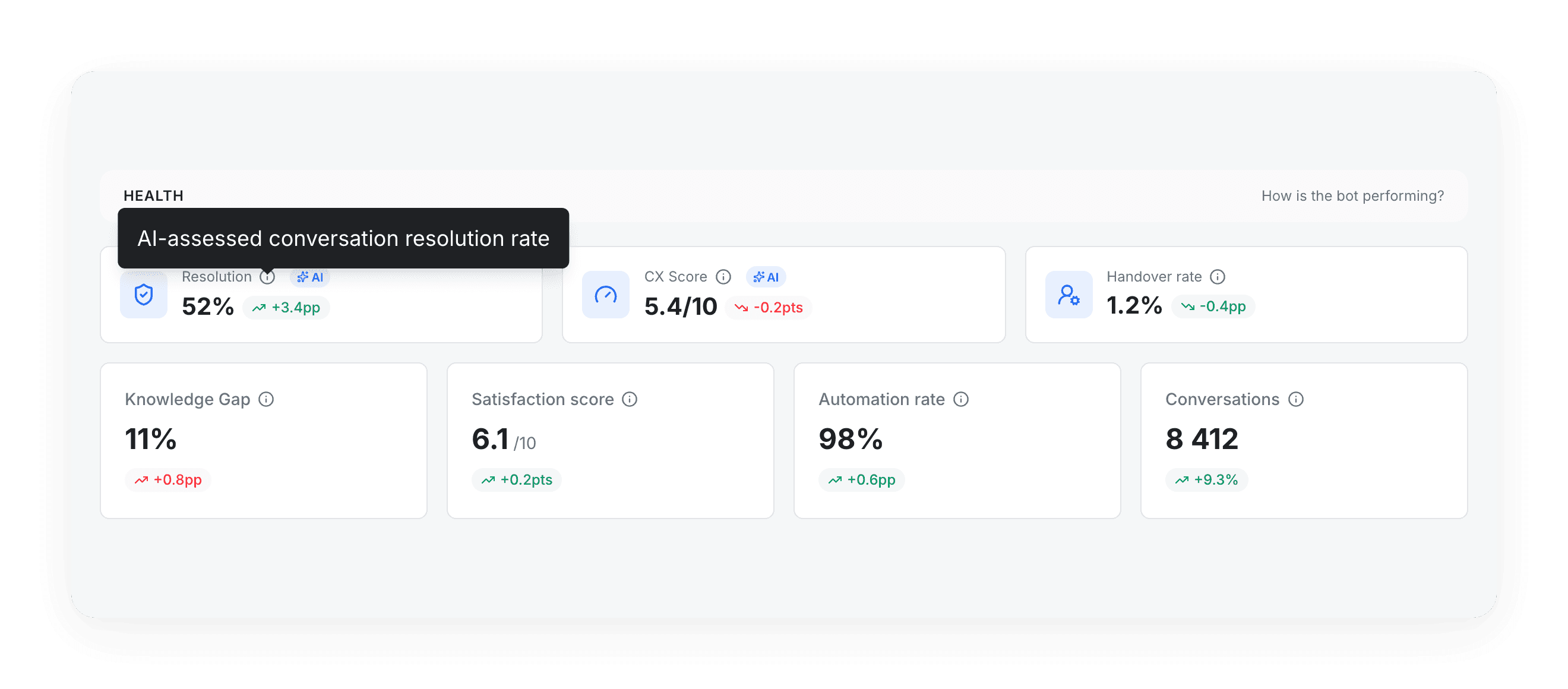
In the ViaSay dashboard, the two metrics sit side by side. The CX Score carries the “AI” badge, which flags a metric that is judged rather than counted.
What should you do when CSAT and the CX Score tell different stories?
When CSAT and the CX Score disagree, it is not an error: it is a lead. Two cases come up again and again. In both, reading a few conversations settles the question in ten minutes and saves a month of work in the wrong place.
A high CSAT with a low CX Score. The few people who vote are your happy customers, while the silent majority has a mediocre experience: average resolution, lots of rephrasing. CSAT was reassuring you wrongly.
In that case, open the topics with the lowest CX Score and read their conversations.
A low CSAT with a reasonable CX Score. The bot is doing its job: requests are dealt with, with little effort, and yet customers vote against it. Usually they are not rating the bot, but something else: an unpopular policy correctly stated, a price, an outage, a delay.
The fix is then not in the bot. Pass the signal on to the team that owns the rule.
Rank your topics by degraded experience, then fix the component that is dropping
The CX Score becomes useful when you rank topics by Volume × (10 − CX Score), meaning by the amount of degraded experience, not by percentage. A topic scored 4.5 over 2,000 conversations therefore weighs more than a topic scored 2 over 40.
In ViaSay, this is the Dissatisfaction Drivers table (the causes of dissatisfaction), in the Sentiment tab.
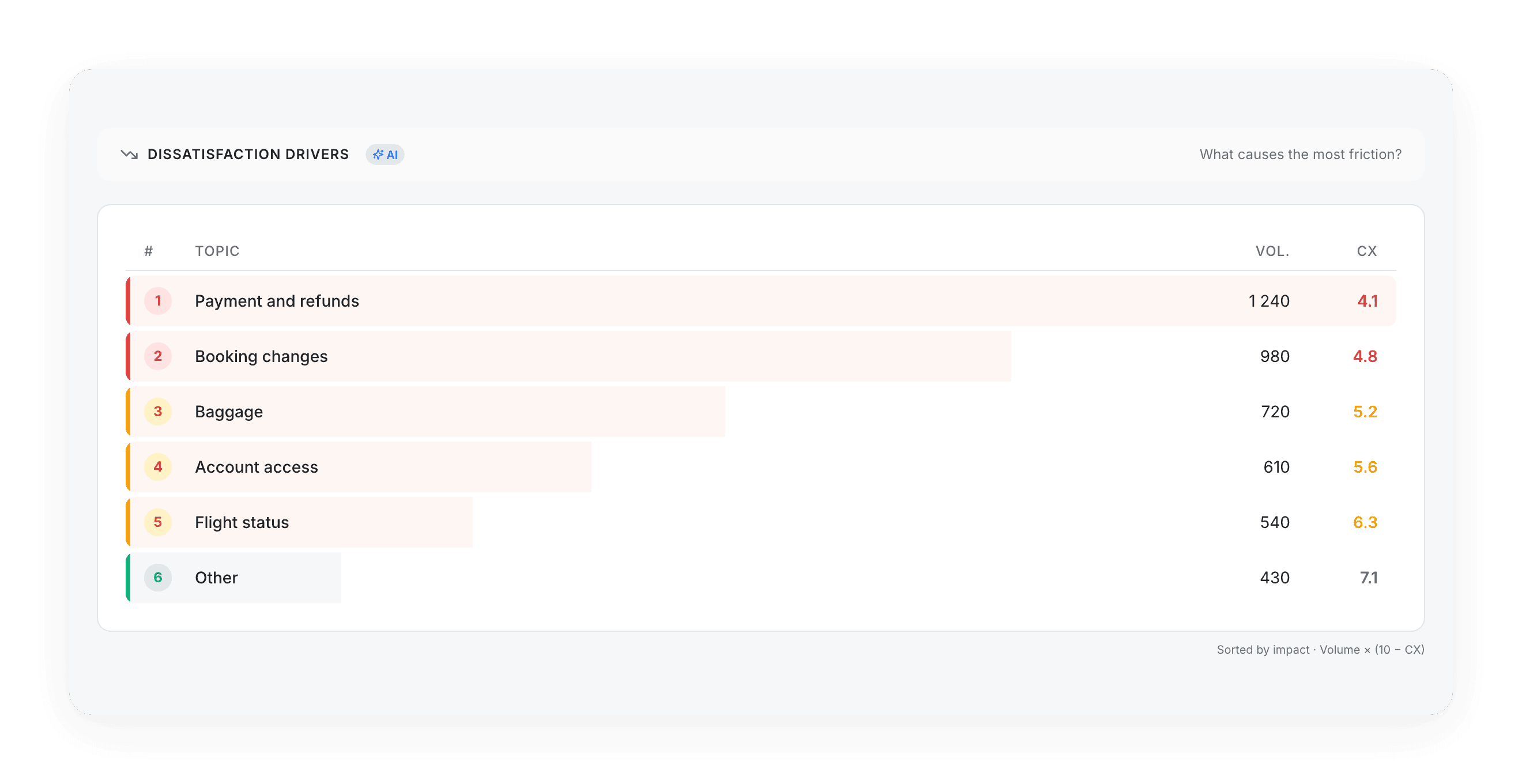
Take the first row, open its conversations, and look for which of the three components is collapsing:
Resolution: follow our 5-step method to improve the resolution rate. It is the heaviest lever, and it pulls the other two along with it.
Effort: the bot understands, but at the third attempt. Look for examples to rephrase, intents that are too close to each other, a badly placed clarifying question. It is the quickest lever to pull on a specific topic.
Sentiment alone, with reasonable resolution and effort: read the conversations, and accept that the answer may not lie in the bot.
See the CX Score of your conversations, topic by topic
A 30-minute demo of AI Quality Monitoring, on your flows and your customers.
Frequently asked questions
What is a good CSAT for a chatbot? Benchmark studies place a healthy chatbot between 75 and 85% positive votes. However, this figure rests on the minority who vote, often less than 10% of conversations. Read it alongside a measure that covers every conversation before drawing any conclusion.
What is a chatbot’s CX Score? It is a score from 0 to 10, calculated by an AI evaluator for every completed conversation. It combines resolution (40%), expressed sentiment (30%) and user effort (30%). It covers 100% of conversations, not just those where someone voted.
Does the CX Score replace CSAT? No. CSAT is an actual customer vote, and the CX Score an audit of the conversation. The two should be read together, and their disagreement is information in itself.
Why is my CSAT good when my customers complain? Because those who vote are not those who complain. CSAT captures the very happy and the very angry, and the majority does not vote. A low CX Score next to a high CSAT signals exactly this case.
How do you improve a chatbot’s CX Score? Rank topics by Volume × (10 − CX Score), then open the conversations of the first one. Identify the component that is dropping: resolution (content, flow), effort (understanding, rephrasing) or sentiment alone (often outside the bot). Fix one thing, then measure again three weeks later.
