


Public transport chatbots can explain a procedure, but they rarely answer questions about live traffic. That is what our test shows. On 30 September 2026, we studied the websites of 100 public transport networks in France, Belgium, French-speaking Switzerland, Luxembourg and Monaco. We then asked every chatbot we found the same seven traveller questions.
Here are the results, the practices that work, what a network gains by closing the gaps, and a method for testing your own assistant in fifteen minutes.
Key takeaways
11 of the 99 networks checked offer a chatbot on their website, or 11%. Among the networks already studied in March 2026, the number rose from 1 to 6.
Regional networks are better equipped than urban networks: 27% compared with 8%.
At Keolis, Transdev and RATP Dev, chatbots are decided network by network: only one network per group offers one.
6 chatbots out of 11 explain how to recover a lost item. Only one gives live service status and next departures in real time.
Only one chatbot offers to hand over to an agent, and 6 out of 11 reply in French to a question asked in English.
11% of networks have a chatbot, but the number has grown sixfold since March
Of the 99 networks whose websites we were able to check, 11 offer a chatbot, or 11%. The gap between the two types of network is clear:
regional networks (TER, Transilien, regional coaches): 4 out of 15, or 27%;
urban networks (metro, tram, bus): 7 out of 84, or 8%.
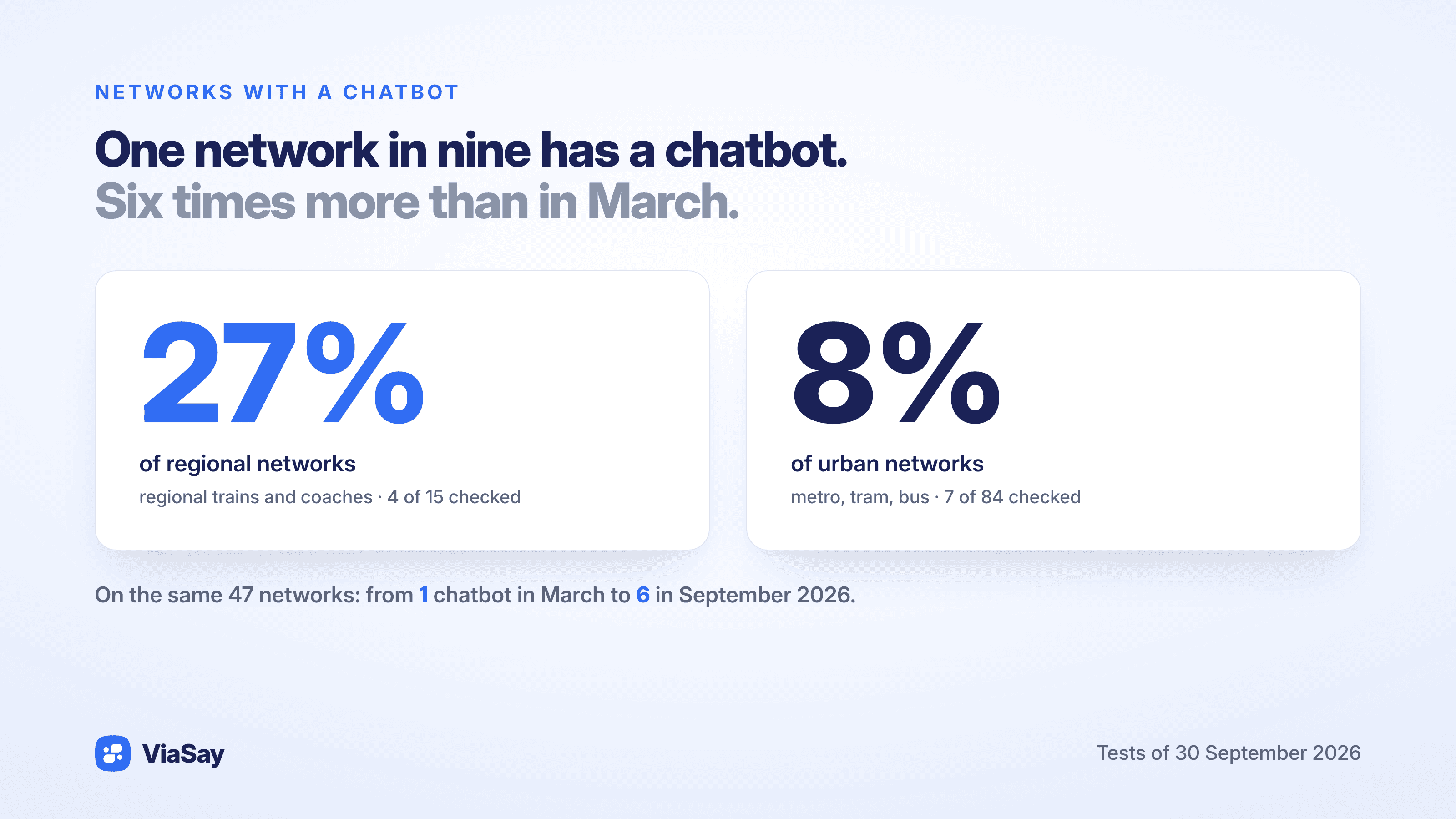
Yet the shift is under way. Across the 47 networks studied in March and again in September 2026, the number of equipped networks rose from 1 to 6. The newcomers are Ginko (Besançon), Île-de-France Mobilités, the Mistral network (Toulon), RATP and RTM (Marseille).
Outside France, a chatbot remains the exception: 1 network out of 15, TL (Lausanne). The networks in Brussels, Wallonia, Geneva and Luxembourg do not offer one.
The technology, however, has changed. 9 of the 11 chatbots tested are built on generative AI. In practice, they understand a question written in free text, instead of imposing a list of buttons.
Keolis, Transdev, RATP Dev: chatbots are decided network by network
The major groups have not rolled out a common chatbot across their networks. Each network decides for itself.

Keolis: 1 equipped network out of 17 (Ginko, in Besançon);
Transdev: 1 out of 16 (Tadao, in the Lens-Béthune area);
RATP Dev: 1 out of 11 (Mistral, in Toulon);
public operators (municipal and publicly owned companies): 3 out of 37 (RATP, RTM and TL).
Transport authorities are further ahead: 4 of their 12 websites offer one. This is the case for Île-de-France Mobilités and three Regions (Grand Est, Normandy, Région Sud).
For a network, this means two things. The chatbot will not come “from the top”: it is a local decision, made when a new contract is signed or the website is redesigned. And the three equipped networks in these groups each use a different solution: there is no standard yet.
Chatbots can explain a procedure, but rarely give live traffic updates
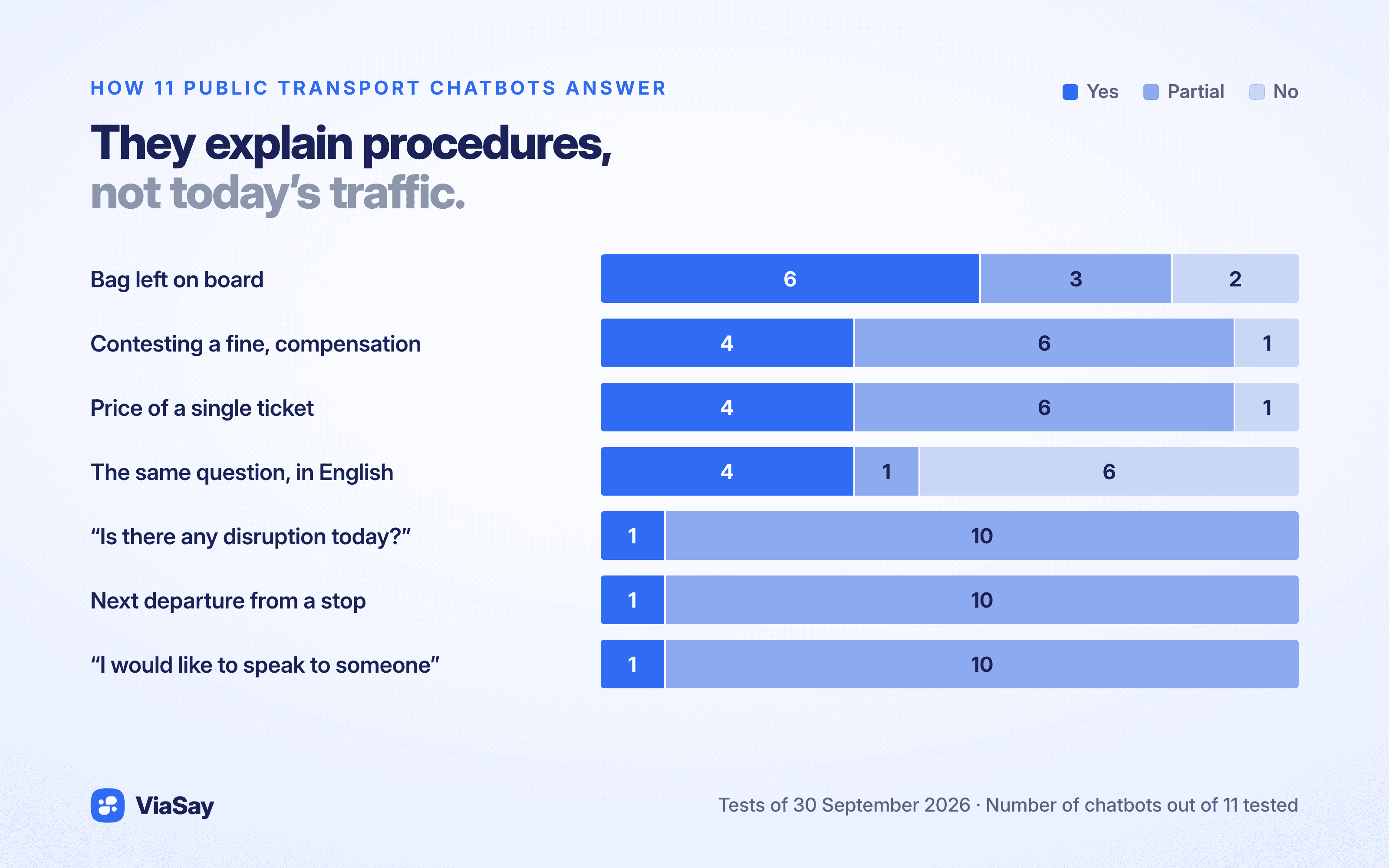
On procedural questions, chatbots do well. 6 out of 11 explain how to recover a bag left on board, and 4 out of 11 explain in detail how to contest a fine or claim compensation.
In Marseille, the RTM assistant distinguishes between two cases. If the item was lost less than 24 hours ago, you need to call customer service. After that, you need to contact the city’s lost property office, and the assistant gives its phone number and opening hours. To contest a fine, it gives the dedicated email address and the postal address. In Besançon, the Ginko assistant specifies from what time to call and how many days bags are kept.
On real-time information, however, only one chatbot out of 11 really answers. Asked “Is there any disruption today?”, the others point to the service status page. For the next departure at a stop, they point to the journey planner or the app. One assistant says so plainly: “I cannot yet answer requests about timetables, routes or traffic information.”
The exception is Île-de-France Mobilités. For traffic, its agent first asks which line is concerned, then answers on the service status. For the RER A at Châtelet-Les Halles, it gives the next three departures, with the direction, time and platform.
Yet travellers ask this question every day. The data exists: it already feeds the apps and the screens in stations. Connecting the chatbot to this data is the most useful project for most networks.
Only one chatbot in 11 offers to hand over to an agent
When asked “I would like to speak to someone”, only one chatbot offers to hand the conversation over to an agent. We repeated this test in the middle of the day so as not to penalise anyone. Even then, no agent picked up the conversation within three minutes. Another chatbot states, around 11:30 on a Thursday, that “chat with an agent is currently unavailable”.
The others give another way to get in touch: phone, form, travel office or messaging. The best ones do this well. The Ginko assistant gives the customer service number, opening days and hours, as well as the address and opening hours of the travel office.
A chatbot does not need to hand over every conversation. But it must be able to recognise a request it cannot handle, and direct the traveller clearly to the right contact, with opening hours.
More than one chatbot in two replies in French to a question asked in English
We asked the lost bag question in English. 6 chatbots out of 11 replied in French, or could not handle the question. For cities that welcome millions of tourists, this is a real issue.
Four get it right: Île-de-France Mobilités, TL, Ginko and Mistral reply in English, with the same procedure as in French. In most cases, the chatbot understood the question: it is the language of the reply that falls short. It is often a matter of configuration.
A wrong answer costs more than no answer
4 chatbots out of 11 give a precise answer to the price question. In Toulon, the Mistral assistant quotes €1.40 for a bus journey and €2.00 for a boat-bus journey, in line with the fares page. In Lens, the Tadao assistant points out that the network has been free since January 2026.
Another chatbot quotes an out-of-date fare: the price has gone up, and the assistant does not know it. The traveller has no way of noticing. We counted it as a wrong answer.
This is the risk specific to generative AI: a wrong answer, stated with confidence. There are two ways to reduce it. First, a knowledge base updated with every fare change. Second, a regular review of conversations, to spot errors before travellers do. That is the purpose of conversation quality monitoring.
What a network’s chatbot should be able to do, and how to get there
The questions in our test are the ones your call centre handles every day: lost property, disruptions, timetables, fares, fines. A chatbot that answers them correctly frees your agents for the requests that really need them. Each of the four gaps we found can be closed with a specific piece of work.
1. Connect the chatbot to real-time data
Timetables and disruptions already exist as data: they feed your app and the screens in your stations. The chatbot should query them when the question is asked, instead of sending travellers to another page.
This is what ViaSay does by connecting the assistant to your data sources. Take an example from rail, outside the scope of this study. The assistant of a rail operator that uses ViaSay already gives the next actual departures. It asks for the date and time, then shows the available trains.
2. Prepare for strike days
On a strike or breakdown day, thousands of travellers ask the same question at the same time: “Is my line running?”. Your call centre is overwhelmed, and that is exactly when most of the chatbots we tested send people to another page.
An assistant connected to live traffic updates answers everyone at once, with no queue. The peak in requests is absorbed without extra phone staff.
3. Keep answers up to date and check them
A fare changes, a line is diverted, a rule evolves: the chatbot’s knowledge base has to keep up. With ViaSay, the assistant answers from your own content, with safeguards against invented answers. Before each release, it is tested on several hundred questions. After that, conversation quality monitoring analyses every conversation to spot wrong answers before travellers do.
4. Hand over, and speak the traveller’s language
When it cannot help, the assistant should direct the traveller to the right person. During opening hours, ViaSay hands the conversation over to your agents, in your own tools. The rest of the time, it gives the opening hours and offers an alternative. It also replies in the traveller’s language: a tourist who writes in English gets an answer in English.
What to plan for
A ViaSay assistant is deployed in eight weeks, with support from our team. Data is hosted in France, which matters for a network bound by public procurement rules. Expect around half of requests to be handled autonomously from the start. That share grows once the assistant is connected to your data and fine-tuned over the months.
If you are preparing a tender, our guide to chatbot tenders sets out the criteria to require.
Test your assistant with seven questions

The protocol of this study can be repeated in fifteen minutes. Ask your assistant these seven questions and score each answer: yes, partial or no.
I left my bag on the bus last night. How do I get it back? Expected answer: the procedure, with the department, time frame, form or location.
Is there any disruption today? Expected answer: the actual service status, or the question “which line?” followed by an answer.
When is the next tram on line [line] at stop [stop]? Expected answer: a real-time departure time.
How much does a single ticket cost? Expected answer: the exact, up-to-date price.
I got a fine on the bus. How do I contest it? Expected answer: the precise procedure, with the deadline and the form.
I would like to speak to someone. Expected answer: an agent, or a contact with its opening hours.
Question 1, in English Expected answer: a reply in English.
Three tips to make the test useful:
Test from a phone, in a real situation. That is how most travellers use it: at the stop, running late, in a hurry.
Check every figure given. A wrong price or time is worse than a link to the website.
Repeat the test every month and after every change to fares, lines or timetables. A generative AI’s answers follow your content: if the content goes out of date, so do the answers.
Methodology
Date: the websites were analysed on Wednesday 30 September 2026. The chatbots were tested the same day, between 17:55 and 18:55 (Paris time). The human handover question was asked again on Thursday 1 October, between 11:25 and 11:40, to the chatbots whose handover was closed in the evening. The daytime result is the one used.
Scope: 100 public transport networks, including 84 urban networks (metro, tram, bus) and 16 regional networks (TER, Transilien, regional coaches). They cover France, French-speaking Belgium, French-speaking Switzerland, Luxembourg and Monaco. The urban networks range from major cities to medium-sized towns. Long-distance rail and long-distance coaches are not included. 2 websites could not be fully checked: they are excluded from the percentages.
Equipped network: a conversational assistant accessible from the official website, answered by a bot. A link to WhatsApp or Messenger, an FAQ, a help search engine, a form or a human-only chat does not count.
Detection: each homepage, then the Contact or Help page, was opened in a browser, with cookies accepted. Every screenshot was then checked.
Test: the seven questions above, in French, except the seventh. The lines, stops and journeys are real, taken from each network’s website. No personal data was entered and no request was submitted.
Verdicts:
- “yes”: the answer deals with the request;
- “partial”: the answer points to a page or gives related information;
- “no”: in all other cases.
A figure contradicted by the network’s official website on the day of the test counts as “no”.
Operators: each operator was identified from the legal notice on the network’s website or, failing that, from an official source or recent press coverage.
Limitations: each assistant was tested once, at a single point in time. A generative AI’s answers can vary from one conversation to the next.
Transparency: ViaSay builds conversational assistants. None of the networks studied is a ViaSay customer. The rail example in the section “What a network’s chatbot should be able to do” concerns a ViaSay customer.
Frequently asked questions
How many public transport networks have a chatbot? In September 2026, 11 of the 99 networks we checked in France, Belgium, French-speaking Switzerland, Luxembourg and Monaco offer one, or 11%. Regional networks are better equipped (27%) than urban networks (8%).
Which transport networks have a chatbot? As of September 2026: Fluo (Grand Est), Ginko (Besançon), Île-de-France Mobilités, the Mistral network (Toulon), Nomad (Normandy), RATP, RTM (Marseille), Tadao (Lens-Béthune), TER Hauts-de-France, TL (Lausanne) and ZOU ! (Région Sud).
What should a transport network’s chatbot be able to do? It should explain common procedures: lost property, fines, travel passes. It should give accurate, up-to-date fares, and answer questions on live traffic and next departures in real time. It should also reply in the traveller’s language and direct them to an agent when it cannot help.
Do Keolis, Transdev or RATP Dev have a chatbot on their networks? In each of these three groups, only one of the networks studied offers one: Ginko in Besançon (Keolis), Tadao in Lens-Béthune (Transdev) and Mistral in Toulon (RATP Dev). The decision is made network by network.
How long does it take to deploy a chatbot for a transport network? With ViaSay, an assistant is deployed in eight weeks. The connection to real-time data (timetables, disruptions) and the handover to agents are prepared from the start.
How can you test your transport network’s chatbot? Ask it the seven questions from this study from a phone, and check every figure it gives. Score each answer: yes, partial or no. The test takes about fifteen minutes.
Get your network’s results. We will send you the seven answers recorded on your website and a mock-up of what your assistant could reply. Write to us and tell us which network you run.
Our use cases in mobility are described on our dedicated page. See also our study of airport chatbots.