


Airport chatbots handle flight questions well. They are far less comfortable with parking, the traveller’s language and evening requests. That is what our test shows: on 27 September 2026, we asked the chatbots of 105 European airports, 29 of them in France, the same seven questions.
Here are the results, the practices that work, and a method to test your own assistant in fifteen minutes.
Key takeaways
In Europe, 42 of the 104 airports checked offer a chatbot on their website, or 40%. In France, 3 out of 29 do.
9 airports added one between March and September 2026.
74% of chatbots answer “Is my flight delayed?” correctly.
Only 21% let travellers book a parking space within the conversation.
69% reply in the website’s language rather than the traveller’s.
40% of European airports have a chatbot, compared with 10% in France
Of the 104 European airports whose websites we were able to check, 42 offer a chatbot, or 40%. Outside France, the share reaches 52%. In France, 3 airports out of 29 offer one.

Adoption is growing fast. Across the 89 airports checked in March and again in September 2026, the number with a chatbot rose from 33 to 42. The newcomers are Antalya, Edinburgh, Gothenburg, Larnaca, Milan Linate, Ljubljana, Luxembourg, Riga and Turin.
The technology is changing too. Of the 39 chatbots tested, 26 clearly rely on generative AI. In practice, they understand a freely worded question instead of forcing a list of buttons on the traveller.
74% of chatbots answer a flight delay question correctly
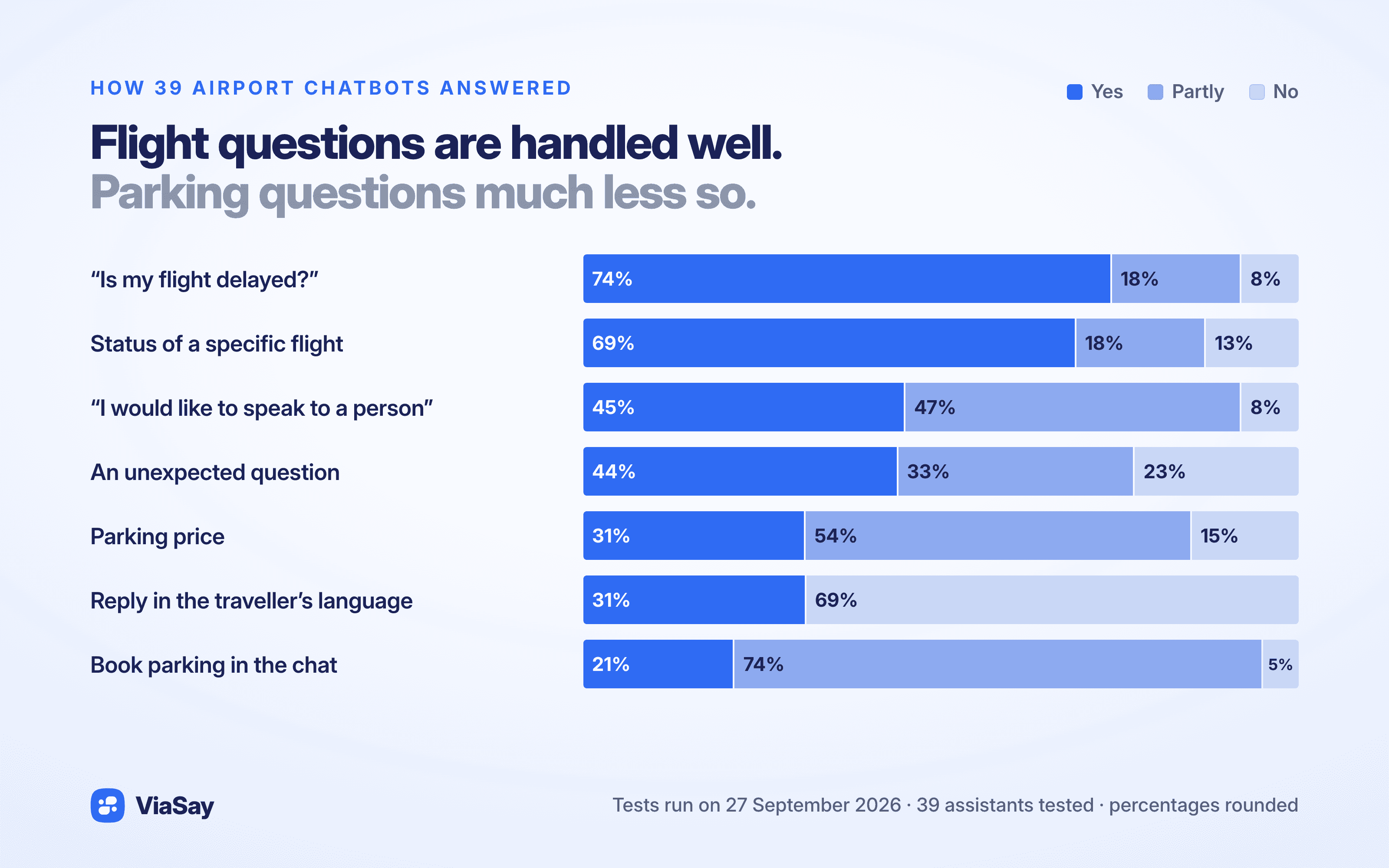
Asked “Is my flight delayed?”, 74% of chatbots answer correctly, usually by asking for the flight number. Given a real flight number, 69% provide an up-to-date status: time, terminal, check-in area or gate.
This is the most mature use case, for a simple reason: the information already exists in a structured form, on the departures board. A chatbot connected to that board answers accurately and quickly. In Frankfurt, for example, the assistant gives the departure time, terminal and check-in area for a flight.
Only 21% of chatbots let travellers book parking within the conversation
Of the 39 chatbots tested, 12 give the price of a week’s parking and 8 allow booking without leaving the conversation. Most send the traveller to the website’s booking page, where they often have to enter everything again.
That is lost revenue. According to ACI World (March 2026), parking accounts for 24.1% of airports’ non-aeronautical revenue worldwide. A traveller who asks for a price is ready to buy: this is the moment the assistant can close the sale.
Madrid shows it can be done. The assistant asks for the terminal and dates, displays the available car parks with their prices, then offers to book within the conversation.
To check your assistant, ask it: “How much does parking cost for a week?”. If it sends you to a page without a price, that is the first connection to look at: the rates already exist in your booking engine.
69% of chatbots do not reply in the traveller’s language
We asked the motorcycle helmet question in a language other than the website’s: in French for airports outside France, in Spanish for French airports. 69% of chatbots replied in a different language from the question. Of the 12 that replied in the right language, 7 belong to the same network of Spanish airports.
For an airport, this is a real issue: its travellers come from all over the world.
Two examples illustrate the problem. To a question asked in French, a major European airport replies in English: “It looks like you are writing in a different language than the one currently selected”. It then asks the traveller to choose between two languages. Another chatbot understands a question asked in Spanish and gives the right answer, but in French.
In both cases, the chatbot understood the question: it is the language of the reply that does not follow. This is usually a configuration issue, which can be fixed without rebuilding the assistant.
In the evening, handover to an agent usually leads to a holding message
When asked “I would like to speak to someone”, 45% of chatbots offer a handover to an agent within the conversation. 47% give another way to get in touch: phone, form or messaging.
On the Sunday evening of the test, this handover mostly ended in holding messages.
In seven cases, the chatbot said agents were not available at that time and gave their opening hours. In eight others, it offered to take a message, with a reply “as soon as possible”. No agent joined during our tests; we did not wait in the queues, so as not to tie anyone up unnecessarily.
Yet evenings and weekends are precisely when a traveller has no one else to turn to. The best chatbots state the opening hours clearly and offer an alternative: a phone number, a form or a callback. In Madrid, the traveller can even choose between a written exchange and a video call.
Faced with an unexpected question, 44% of chatbots find the right answer
Nobody writes a help article called “Where can I leave my motorcycle helmet?”. That is the whole point of the question: it shows whether the chatbot understands an unexpected request and looks for the right information.
44% of chatbots gave a useful answer.
In Toulouse, the assistant points to the helmet storage service and its location: information desk, Arrivals level, hall C. It gives the price (€12 incl. VAT), the maximum storage period (two months) and its source. In Frankfurt, it directs the traveller to the left-luggage office, which accepts items of any kind. Elsewhere, the chatbot offers unrelated buttons or says it did not understand.
Test your assistant with seven questions
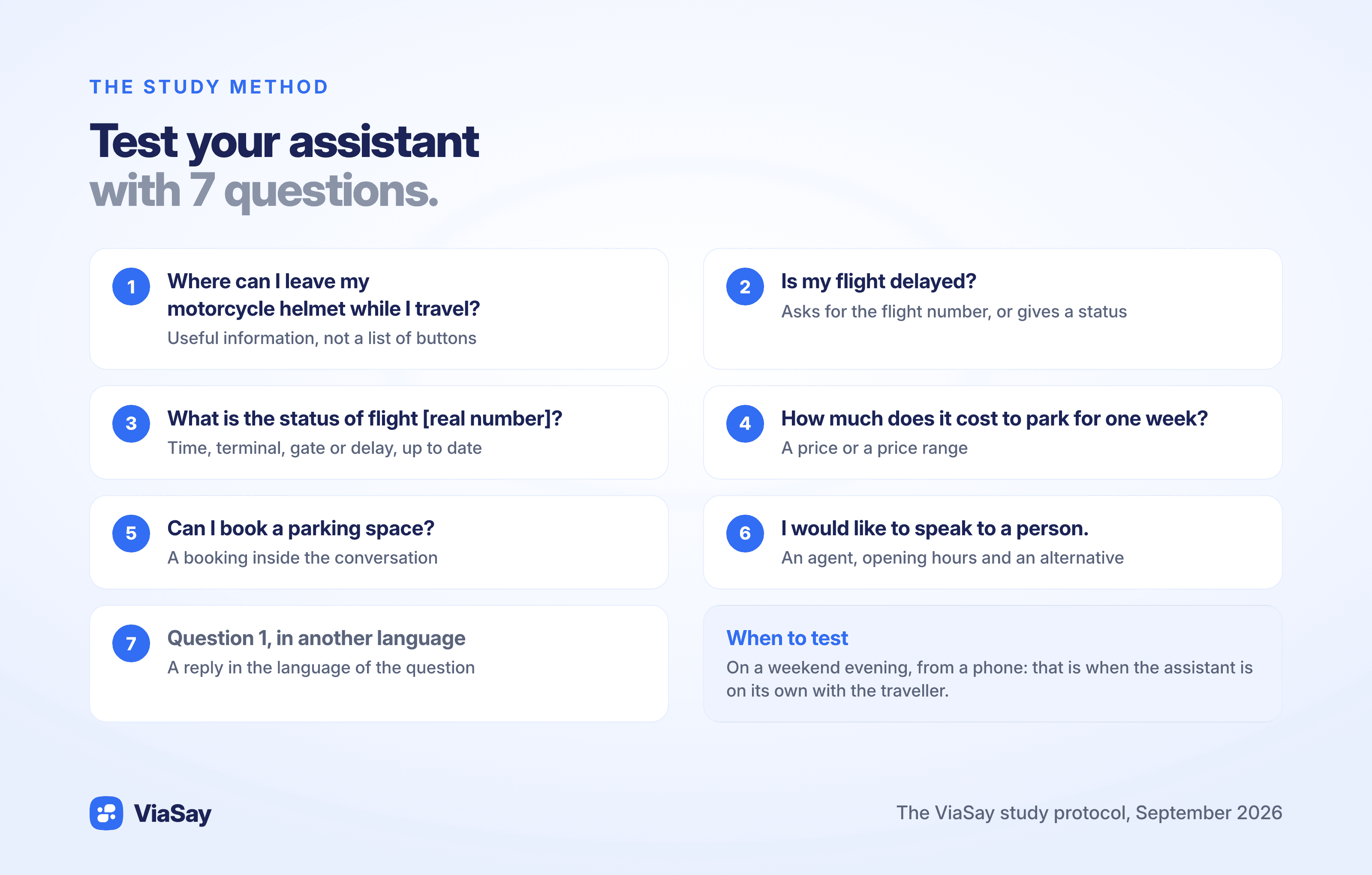
The protocol of this study can be reproduced in fifteen minutes. Ask your assistant these seven questions and score each answer: yes, partial or no.
Where can I leave my motorcycle helmet while I travel? Expected answer: Useful information (storage, left luggage), not a list of buttons.
Is my flight delayed? Expected answer: A request for the flight number, or a status.
What is the status of flight [real number]? Expected answer: Time, terminal, gate or delay, up to date.
How much does parking cost for a week? Expected answer: A price or a price range.
Can I book a parking space? Expected answer: Booking possible within the conversation.
I would like to speak to someone. Expected answer: A handover to an agent, with opening hours and an alternative.
Question 1, in another language Expected answer: A reply in the language of the question.
Three tips to make the test useful:
Test when no one is answering. In the evening and at weekends, the assistant is alone with the traveller.
Test from a phone. That is how most travellers use it, often already on their way.
Repeat the test every month. Generative AI answers change with your content: what worked yesterday can deteriorate without anyone noticing. That is what conversation quality monitoring is for.
In France, 3 airports out of 29 offer a chatbot
Of the 29 French airports checked, 3 offer a chatbot on their website: Lyon, Montpellier and Toulouse. In France the subject is still emerging, whereas it is becoming standard across much of Europe.
For French airports, this gap is also an opportunity. The practices that work are known and proven elsewhere, and an assistant can now go live in a few weeks. Our use cases in transport and travel are described on our travel page.
Methodology
Test date: Sunday 27 September 2026, between 10pm and midnight (Paris time).
Scope: 105 European airports. These are the 91 airports from our March 2026 survey, plus 15 French airports, to cover 29 airports in France. The website of Heraklion airport, under maintenance on the day of the test, was excluded.
Equipped airport: a conversational assistant accessible from the official website, as a chat window or a module embedded in the page. A simple link to WhatsApp or Messenger, an FAQ page or a contact form does not count.
Detection: each homepage was opened in a browser, with cookies accepted. Eight websites protected against bots were checked manually on 30 September 2026; Geneva’s remains to be confirmed. We recorded the scripts and chat elements, then checked every screenshot.
Test: the seven questions above, in English, or in French for French airports. The flight numbers are real flights, taken from each airport’s departures board. No personal data was entered and no booking was made.
Verdicts: “yes” if the answer deals with the request, “partial” if it points to a page or to related information, “no” otherwise. For human handover, “yes” means a transfer to an agent offered within the conversation, even outside opening hours.
Limitations: each assistant was tested once, at a given moment. Generative AI answers can vary from one conversation to the next, and an evening test penalises human handover.
Transparency: ViaSay builds conversational assistants. The Toulouse-Blagnac airport assistant runs on ViaSay. All assistants were tested with the same protocol.
Frequently asked questions
How many European airports have a chatbot? In September 2026, 42 of the 104 European airports we checked offer a chatbot on their website, or 40%. The share reaches 52% outside France.
Which French airports have a chatbot? Of the 29 French airports checked in September 2026, 3 offer a conversational assistant on their website: Lyon, Montpellier and Toulouse.
What should an airport chatbot be able to do? At a minimum, it should give a flight’s status from its number, answer questions about access and services, and state parking prices. It should also reply in the traveller’s language and hand over to an agent while stating opening hours. The most advanced ones let travellers book parking within the conversation.
Can an airport chatbot book a parking space? Yes, but it is still rare: 21% of the chatbots tested allow it without leaving the conversation. Most send the traveller to the website’s booking page.
How can you test your airport’s chatbot? Ask it the seven questions from this study, ideally on a weekend evening and from a phone, and score each answer: yes, partial or no. The test takes about fifteen minutes.
Would you like to receive the answers recorded for your airport, or put your own assistant through this test? Write to us and we will send them to you.