


🚀
GUIDE GRATUIT
RFP Chatbot : Ne partez pas d'une page blanche
Un mode d'emploi pensé pour les métiers avec un guide pas à pas pour rédiger chaque section de votre appel d'offres.
Méthodologie guidée : Quoi écrire dans chaque chapitre (Contexte, Fonctionnel, Tech)
Concepts clés décryptés : RAG, LLM, Base de connaissance
Modèles inclus : Structures prêtes à l'emploi pour vos cas d'usage
👉 Télécharger le guide
An AI chatbot's resolution rate, meaning the share of conversations counted as resolved, does not have the same definition at the three vendors compared here. Since two of them charge per resolution, that definition is also a line on the invoice. Here is what each one counts, criterion by criterion, and four questions for reading any figure.
This comparison is based on each vendor's public documentation, consulted in September 2026. Definitions change: Intercom changed its own in July, Zendesk in May. We will update this page whenever a documented change occurs.
Key takeaways
Each vendor follows its own logic: customer behaviour at Intercom, a tier verified by a language model at Zendesk, a verdict explained by an evaluator at ViaSay.
Customer silence is the main point of divergence: resolved at Intercom, unverified at Zendesk, judged on what came before it at ViaSay.
Escalation diverges too: excluded from the count at Intercom and Zendesk, it counts as a resolution at ViaSay if it is correct.
When billing depends on the definition, read the definition before the price.
How does each vendor define resolution rate?
The three vendors diverge on eight criteria, from who judges a resolution to how it is billed. The two differences that matter most are customer silence and escalation to a human. The denominator refers to the conversations on which the rate is calculated.
Who decides that a conversation is resolved?
Intercom Fin: the customer's behaviour after Fin's last answer.
Zendesk AI agents: a language model reviews the conversation and confirms the resolution, or not.
ViaSay: an AI evaluator separate from the bot reviews every completed conversation.
Does customer silence count as a resolution?
Intercom Fin: yes, it is an "assumed resolution" if the customer leaves without asking for further help.
Zendesk AI agents: not by default. Without verification by the language model, it is a "Contained resolution", which is not billed.
ViaSay: silence decides nothing; the verdict is based on what the customer was given before leaving. A pending step (a question, an identifier, a choice) is set aside.
Escalation to a human
Intercom Fin: not billed and not counted as a resolution, unless a "Procedure handoff" has been configured, in which case it is billed.
Zendesk AI agents: "Assisted escalation", outside resolutions.
ViaSay: counted as resolved if it is correct (limit recognised, clean transfer), unresolved if the bot refuses it without offering an alternative.
Denominator
Intercom Fin: conversations where Fin had a chance to answer (since July 2026, excluding "Fin Constrained").
Zendesk AI agents: conversations handled by the AI agent.
ViaSay: 100% of completed conversations, scripted ones included.
Verification
Intercom Fin: no review, but a behavioural rule (confirmation, or no new request).
Zendesk AI agents: review by a large language model (LLM). The end-of-conversation window is 2 hours for messaging (adjustable up to 72 hours) and 72 hours for email.
ViaSay: review by the evaluator once each conversation has ended, with a stored, justified verdict.
Verdict viewable per conversation
Intercom Fin: one "outcome" per conversation.
Zendesk AI agents: one "tier" per conversation.
ViaSay: one verdict and its one-sentence justification per conversation.
Cause of failure
Intercom Fin: no.
Zendesk AI agents: no.
ViaSay: yes, missing information in the knowledge base (a knowledge gap) is distinguished from other causes.
Billing
Intercom Fin: $0.99 per resolution.
Zendesk AI agents: per "Verified resolution", depending on the plan subscribed to.
ViaSay: an annual licence with a volume of conversations included, with no per-resolution billing.
Sources: Fin AI Agent outcomes, Update to Fin performance metrics, Zendesk: About automated resolution tiers.
Intercom Fin counts a resolution based on customer behaviour
At Intercom, what the customer does after Fin's last answer defines a resolution. If they confirm the answer works for them, the resolution is confirmed; if they leave the conversation without asking for further help, it is "assumed". Both are billed at $0.99.
Two cases fall outside the count. An escalation following Fin's default logic is neither billed nor counted as a resolution. When Fin asks a clarifying question the customer never answers, the conversation is "abandoned": no resolution state, nothing billed.
Since July 2026, Intercom has also removed from the denominator "Fin Constrained" conversations, where Fin was active but had no chance to answer. In the official example, the resolution rate goes from 33% to 50%, while the containment rate, calculated on the total, does not move. It is a defensible denominator correction, and Intercom was transparent enough to document it with a before-and-after.
What you need to know: an assumed resolution rests on silence. A customer who received a generic answer and closed the window counts as resolved, and as billed. This is the point your teams should watch in the reports.
Zendesk only bills resolutions verified by a language model
Since 18 May 2026, Zendesk has classified every conversation handled by an AI agent into one of three tiers. Only the "Verified resolution", confirmed by a language model, is billed; the other two tiers do not count towards the quota.
Assisted escalation: the AI agent collected data or authenticated the customer, but the conversation was transferred to a human (outside the quota).
Contained resolution: the AI agent answered and the customer asked nothing further, but verification by the language model did not confirm the resolution (outside the quota).
Verified resolution: the AI agent answered, the customer did not ask for further help, and a language model confirmed the issue was resolved. This is the billed tier.
The conversation is considered ended 2 hours after the last message for messaging (adjustable up to 72 hours), and 72 hours after for email.
What you need to know: this is currently the definition closest to what the word "resolution" actually means. Verification by a language model follows the same logic as an AI evaluator. The difference lies in scope: only conversations handled by the AI agent are classified, and escalation is by design outside resolution.
At ViaSay, an AI evaluator explains the verdict on every conversation
At ViaSay, an AI evaluator separate from the bot reviews every completed conversation, including those handled by scripted journeys without generative AI. It answers four questions: what was the conversation about, was the request dealt with, did the bot have the information, and how did the user experience it?
Three definitional choices set this verdict apart from the previous two.
A correct escalation is a resolution. A bot that recognises the request is beyond its scope and transfers it cleanly has dealt with the request. A bot that refuses to escalate without offering an alternative, or transfers a question it knew how to handle, has failed.
This choice avoids tuning the bot to hold on to the customer at all costs.
Silence decides nothing. The verdict is based on what the customer was given before leaving: was the answer relevant, the redirection valid, the escalation justified?
A customer who left without a word after being given a usable route is resolved; one who left after a generic answer is not. If they leave while the bot was asking for a booking number or offering a choice, the conversation is set aside. Nothing was delivered, so nothing is judged.
This is the opposite of an assumed resolution, where silence counts as agreement by default.
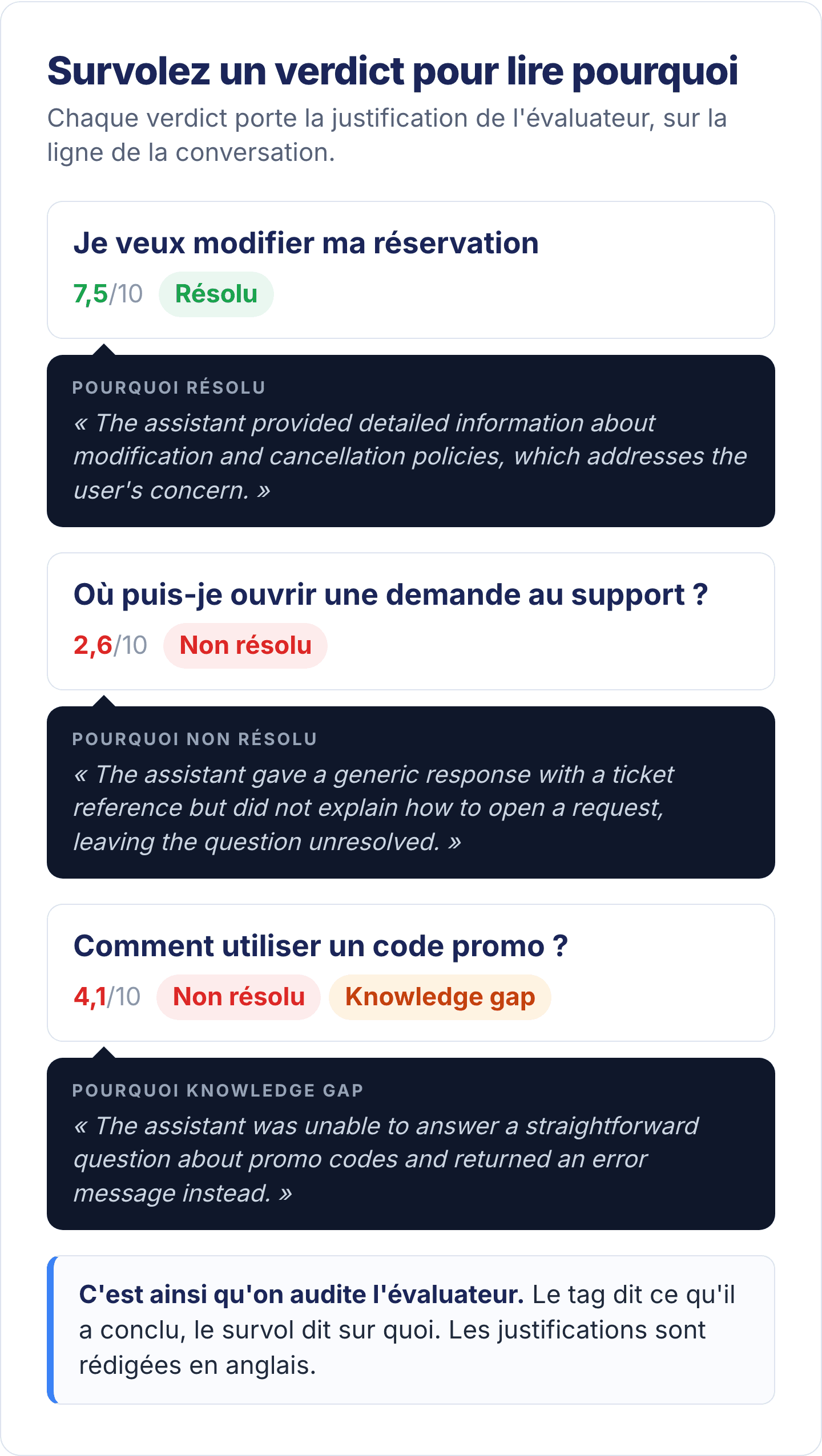
Every verdict is justified. On each conversation, hovering over the verdict label shows the reason in one sentence. The evaluator can get it wrong, but its mistakes remain visible.
The business model also removes a bias: since nothing is billed per resolution, we have no reason to count generously.
What you need to know: with this definition, ViaSay customers in production achieve resolution rates between 50 and 85%. This is lower than the usual containment figures, because the definition is deliberately strict.
How should you read the resolution rate claimed by any vendor?
Four questions are enough to put any resolution rate in context: silence, escalation, the denominator and access to the verdict. Ask every vendor these questions before comparing figures or prices.
Does silence count as resolved? If so, the figure includes silent abandonments.
Is escalation a failure, a success, or excluded from the count? Each answer pushes the bot in a different direction.
What is excluded from the denominator? A denominator correction is legitimate if the containment rate is still calculated on the total, alongside it.
Can you open the conversation behind the verdict, and read why? If not, the figure cannot be verified.
These four questions are part of the 12 questions to ask vendors in an AI chatbot call for tenders.
Compare vendors on your own conversations
A 30-minute demo on your topics and your journeys, with the unresolved conversations screen.
Frequently asked questions
What is the definition of a chatbot's resolution rate? It is the share of conversations a chatbot counts as resolved, but each vendor defines "resolved" in its own way. Two rates can therefore only be compared on the same definition.
How does Intercom Fin count a resolution? A resolution is counted when, after Fin's last answer, the customer confirms the answer works for them or leaves the conversation without asking for further help. Each resolution is billed at $0.99. A default escalation is neither counted nor billed, and neither is a conversation abandoned after a clarifying question.
What is a "Verified resolution" at Zendesk? Since 18 May 2026, it is a conversation where the AI agent answered and the customer did not ask for further help. A language model has also confirmed that the issue was resolved. It is the only billed tier; unverified "Contained resolutions" and assisted escalations do not count towards the quota.
Why did Intercom's resolution rate go up in July 2026? Because "Fin Constrained" conversations, where Fin had no chance to answer, were removed from the denominator. In the official example, the rate goes from 33% to 50% with no change to the containment rate.
How does ViaSay count a resolution? An AI evaluator separate from the bot reviews 100% of completed conversations, scripted ones included, and judges whether the request was dealt with. Every verdict is justified in one sentence, and nothing is billed per resolution.
