


More than one conversation in two with a social housing landlord’s chatbot takes place before 9 a.m., after 6 p.m. or on the weekend. This is the first finding from the chatbots of two social housing landlords in production, which we analyzed from July to September 2026. Here is what tenants and housing applicants really ask, what the chatbot cannot do yet, and where to start if you are preparing yours.
The essentials
53% of conversations take place outside office hours, including 23% on the weekend.
Requests depend on where the chatbot is installed. On the tenant portal, 44% of conversations are about the portal itself. On the corporate website, 53% come from housing applicants.
92.6% of conversations end successfully, according to the AI that evaluates each exchange: the tenant gets an answer or the right pointer.
Questions about an individual file, such as the progress of an application, require a connection to the landlord’s information system.
Some information never goes through the chatbot, such as a building’s access code: this is a rule to write before going live.
More than one conversation in two takes place outside office hours
On the chatbots of the two social housing landlords studied, 53% of conversations take place before 9 a.m., after 6 p.m. or on the weekend. Tenants write early in the morning, before leaving for work, and on Saturdays. These are precisely the times when the tenant relations department, or the customer relations center, does not answer the phone.
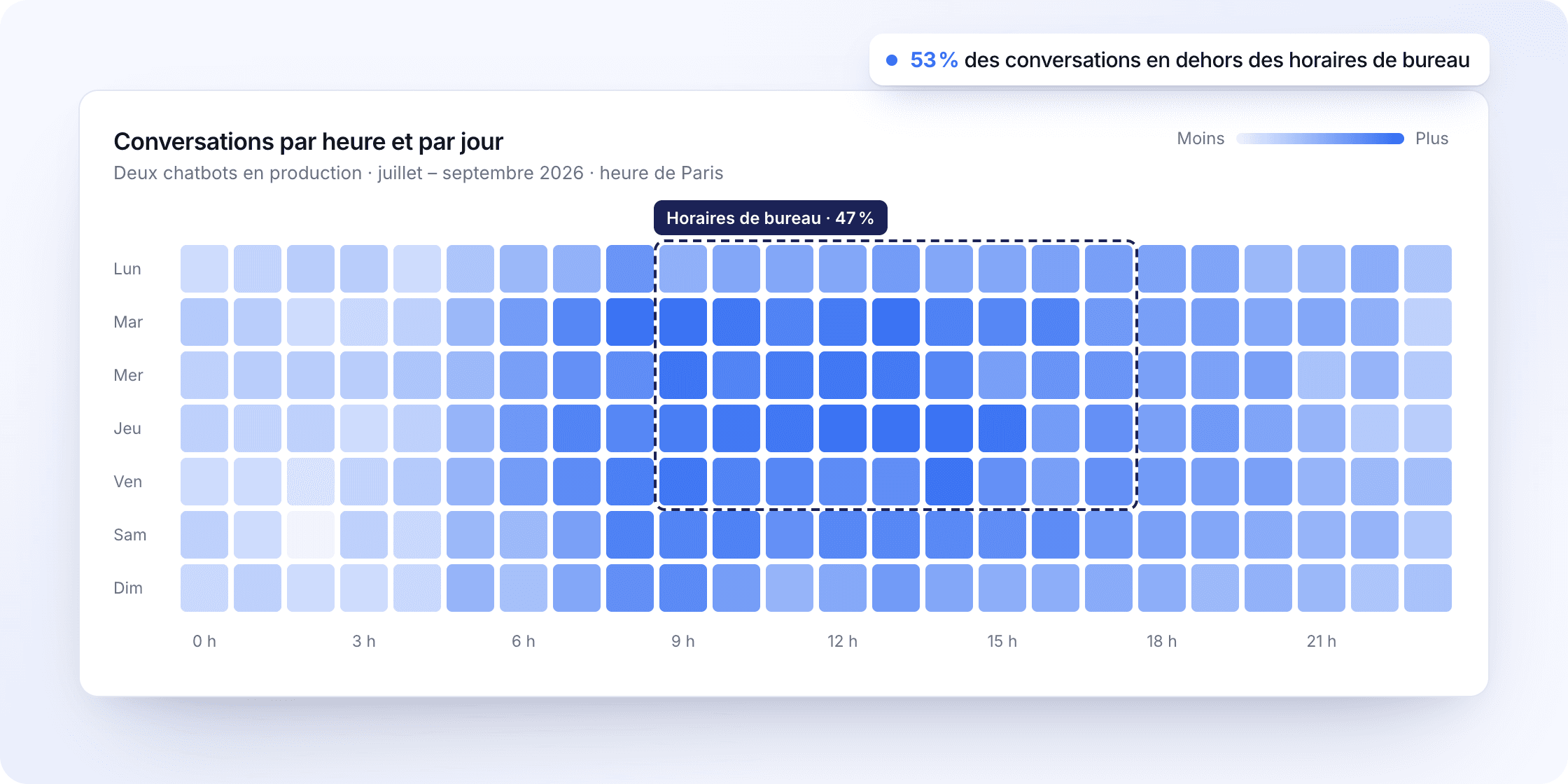
The breakdown is consistent from one landlord to the other:
22% of conversations take place before 9 a.m.;
18% take place after 6 p.m.;
23% take place on the weekend, with 14% on Saturday and 9% on Sunday.
The busiest hour of the week is 9 a.m., just ahead of 1 p.m. and 8 a.m. At one of the two landlords, the tenant relations department opens at 9:30 a.m.: the 8 a.m. peak therefore falls before opening. Its manager had noticed it themselves, while following the chatbot’s first weeks.
For a landlord, the consequence is simple. The chatbot does not replace the phone reception: it covers the hours when nobody can answer. Check your opening hours, then look at how many requests arrive outside them.
A social housing chatbot serves two audiences, tenants and applicants
A social housing chatbot does not receive the same questions depending on where it is installed. On the tenant portal, it answers existing tenants who want to complete a procedure. On the corporate website, it mainly answers housing applicants, who want to know how to submit an application and how long to wait.
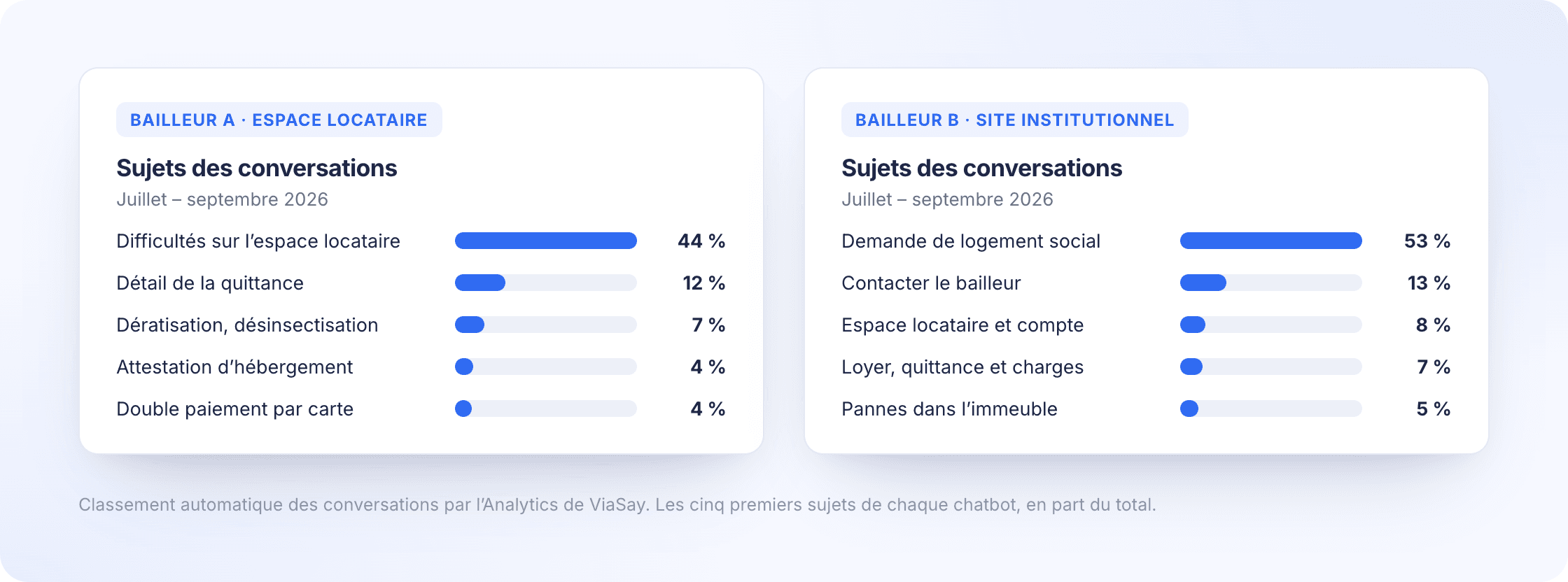
At landlord A, the chatbot is installed on the tenant portal, that is, the online space where the tenant consults their documents and pays their rent. The top five topics there are:
difficulties accessing and using the tenant portal: 44%;
the detail of a line on the rent receipt: 12%;
rodent and insect control: 7%;
the certificate of residence: 4%;
double payment by bank card: 4%.
At landlord B, the chatbot is installed on the corporate website. Social housing applications account for 53% of conversations, far ahead of looking for a contact within the landlord (13%) and the tenant portal (8%).
Applicants ask precise questions: the documents to provide, the renewal of the unique number, allocation timeframes. Many have already submitted their file and have been waiting for an answer for months. For them, reciting the procedure is not enough: the answer must acknowledge the wait and indicate what depends on them.
The tenant portal is tenants’ first topic
The tenant portal concentrates the procedures, and therefore the questions. Logging in, resetting a password, understanding an error message: at landlord A, these difficulties account for 44% of conversations. The chatbot becomes the tenant portal’s guide.
Every blocked procedure produces a question. The chatbot answers by explaining the steps to follow. It then points to the right section, for example “My documents” for a rent receipt or “My payments” for a payment.
Conversations also reveal what does not work. When the same question comes back every day about a specific procedure, it is often the page or the feature that needs rework, not the chatbot’s answer. The project team at one of the two landlords sees it: the chatbot also shows what the landlord needs to improve.
Try the exercise: list the five most frequent procedures on your tenant portal, and check that a clear answer exists for each, with the link to the right section.
Questions about an individual file require a connection to the IS
A chatbot answers well when a rule or a procedure needs to be understood. It struggles as soon as the question concerns a specific file: “where is my transfer request?”, “why do I have to pay this amount?”. To answer, it must be connected to the landlord’s information system, that is, its CRM or its ERP.
Neither of the two chatbots studied is connected to the information system yet. They answer from the landlord’s content: website, tenant portal, guides and procedures. For a file question, they explain the procedure and point to the right contact.
This is why the 92.6% rate must be read with its definition. A conversation counts as successful when the tenant gets an answer or the right pointer. Part of the conversations therefore end with a pointer, not with an answer about the file itself.
Both landlords are preparing the next step: connecting the chatbot to their information system, so that it recognizes the identified tenant, consults their file and creates the request on their behalf. One of them considers it essential. Starting without this connection is still useful: you first measure real requests, then you connect what matters.
Some answers come down to rules, not technology
A social housing chatbot must know what it never says. At one of the two landlords, tenants often asked for their building’s access code. The rule was written with the team: the chatbot never gives out a code and points to the caretaker.
Other rules of the same kind quickly become necessary:
do not share the name or direct contact details of an employee;
point to the caretaker, the agency or the on-call service depending on the time and the nature of the request;
remind that a complaint must be made in writing, if that is your procedure.
These rules require no development. They are decided with the tenant relations department, before going live, then adjusted as conversations come in.
What to do to prepare your organization’s chatbot
List your 20 most frequent questions. Start from calls, emails and walk-ins at reception, with your advisors.
Choose where to install the chatbot. On the tenant portal, it will serve your tenants; on the corporate website, your applicants. Plan separate answers for each audience.
Write your rules. What the chatbot never shares, and who it points to depending on the time: caretaker, agency, on-call service.
Prepare for predictable peaks. Heating restart, service charge adjustment, supplementary rent survey: publish the answers before the questions arrive.
Review conversations every month. Spot rising topics, complete the answers, then decide when to connect your information system.
Frequently asked questions
What is a chatbot for a social housing landlord? It is a virtual assistant, also called a conversational agent, installed on the website or tenant portal of a social housing organization. It answers in writing, at any hour, the questions of tenants and housing applicants, from the landlord’s content.
At what time do tenants write to their landlord’s chatbot? On the two chatbots studied, 53% of conversations take place outside office hours. The busiest hour is 9 a.m., and 23% of conversations take place on the weekend.
Can a chatbot replace the tenant relations department? No. It handles simple questions at any hour and directs the rest to the right contact. Complex technical requests and sensitive situations remain handled by the teams.
Can a chatbot answer about a tenant’s file? Yes, if it is connected to the landlord’s information system. Without this connection, it explains the procedures and points to the right contact for file-specific questions.
Is a social housing landlord’s chatbot GDPR compliant? Yes, under two conditions: data hosted in the European Union, and a landlord who keeps control of the content and the conversations. With ViaSay, conversations and the knowledge base are hosted in France.
Can a social housing landlord buy a chatbot through UGAP? Yes, if the solution is listed with UGAP, the public purchasing agency: this is the case for ViaSay. By going through the agency, a social housing organization does not have to launch its own competitive tender.
Methodology
Period: from July 1 to September 30, 2026.
Scope: the chatbots of two social housing landlords, both built with ViaSay. The first is installed on the tenant portal (3,488 conversations), the second on the corporate website (1,187 conversations). That is 4,675 conversations in total.
Source: ViaSay Analytics, which automatically classifies each conversation by topic and evaluates whether it succeeded.
Successful conversation: the tenant obtained an answer to their request or the right pointer, without human intervention. The 92.6% rate is calculated on the 4,532 engaged conversations, that is, those where the user actually asked a question.
Office hours: Monday to Friday, 9 a.m. to 6 p.m., Paris time.
Limits: two landlords, a quarter that includes summer, and topic labels specific to each chatbot. The teams’ observations come from our follow-up meetings with the two landlords.
Preparing a chatbot for your organization? Start with the list of your 20 questions. To see what a chatbot would answer to your tenants, discover our page dedicated to social housing landlords.
ViaSay is listed with UGAP: if you are preparing a call for tenders, contact us.